
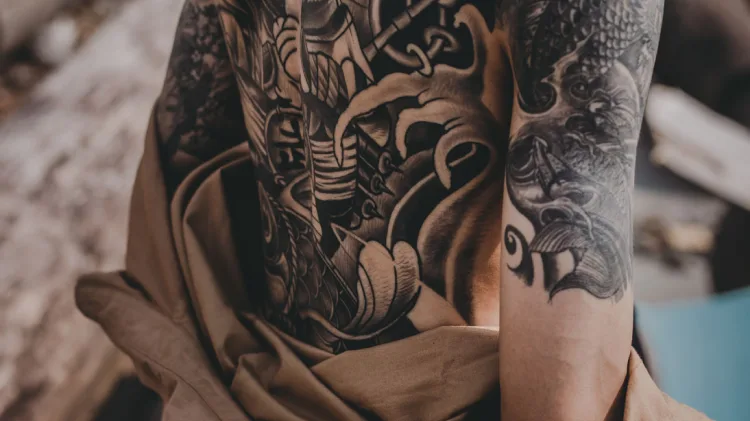
We’ve discovered what makes the color of tattoos so special, how it interacts with the skin, and the relationship between the two. Skin researchers know exactly why the color stays on the skin and how a tattoo changes the skin. And, of course, they also know what kind of care tattooed skin needs. Now we know, too.

Skin that's the same color as a tattoo. What's going on there?
Getting a tattoo involves injecting a special ink under the skin using needles of various thicknesses. Tattoo needles come in many different shapes, and the ink can be red, black, blue, or green. However, the needle always penetrates up to two millimeters deep into the skin. It reaches the dermis, which lies beneath the top layer of the skin (the epidermis). The dermis can retain the colored pigments for a long time.
The pigments that end up in the epidermis during the tattooing process eventually fade away. The epidermis is constantly renewing itself. After about three or four weeks, these superficial colors fade away again. This is known as fading and is a natural process. A little color always remains in the epidermis; this is normal. It has nothing to do with the tattoo artist’s skill.
Let's be clear: tattoo artists use special needles to apply the tattoo ink to the dermis, where it remains for a long time.
Get a tattoo in 3 steps

You’ll receive a personalized tattoo consultation. Contact us via email or Super Chat (icon in the bottom right corner).

Book your appointment.

Your dream tattoo will come true in a relaxed atmosphere.

What is tattoo ink made of?
Indigenous cultures use a mixture of ash, charcoal, and fat for tattooing. They inject the color under the skin using a needle made of bamboo or bone shards. This is unthinkable in Europe, where tattoo inks are subject to strict regulations. Tattoo colors consist of small solid pigments. These particles are so small that we cannot even see them. Only under high magnification can you see that the color is made up of solid particles suspended in a liquid. It is the pigment particles that give the tattoo its color. The liquid that holds them together consists of solvents and preservatives and, in principle, has nothing to do with the color of the tattoo.
Do you suffer from allergies? Then you should pay close attention to the ingredients in tattoo ink. Some ingredients can cause allergic reactions. Just ask the tattoo artist what inks they use. You should also ask for a list of the ink’s ingredients. Generally, inks can be traced using an identification code—that is, the manufacturer’s production number.
So we can’t say for certain what tattoo inks are made of. The exact ingredients and their proportions vary depending on the manufacturer and the product.

How does the color of the tattoo look once it's done?
Your tattoo is still fresh, and you have a band-aid over it. Take a close look at the band-aid: it’s colored, isn’t it? Some of the tattoo ink is carried away by the fluid from the wound after the tattoo is applied. That’s the color you see on the band-aid. The scab that forms on the tattooed skin may also be colored. Don’t panic: all of this is completely normal. Tattoo artists know this and will design your tattoo with these color losses in mind.
But why does the body simply push the ink out? It’s supposed to stay in the skin. Tattoo ink is, in principle, a foreign substance to your body. And foreign substances have no place in wounds. That’s why the body tries to eliminate or break down as much of the ink as possible. A fairly significant portion of the tattoo ink is transported to the lymphatic system during the wound healing process. This mainly consists of small particles (the pigments) and soluble components of the ink that end up there. Only the parts of the tattoo ink that are too large to be transported remain in the dermis. This is the ink that forms your tattoo.
Side Note: The Skin: Epidermis, Dermis, and Subcutaneous Tissue
Some of the ink ends up in the epidermis during the tattooing process. But the epidermis renews itself every three or four weeks. That is why the ink in the epidermis fades quickly. Skin cells constantly regenerate through cell division in the basal layer. This is the boundary between the epidermis and the dermis.
Beneath the epidermis lies the dermis. This layer of skin contains a network of collagen, proteoglycans, and other fibers that make the skin resistant to tearing and elastic. This firm network serves as a support for the dermis. Because this layer of skin is so firm, it reliably stores the larger pigments that give the tattoo its color. But the dermis also has a rich blood supply and is permeated by lymphatic vessels. And the dermis also contains immune cells that help heal the wound after the tattoo is applied.
The subcutis lies beneath the dermis. The subcutis consists mainly of fat cells and connective tissue and does not usually come into contact with the tattoo ink. This raises the question: How much pigment remains in the skin after the tattoo has healed? This varies from person to person. Up to 80% of the originally applied ink can break down and be eliminated. This happens because some of the ink is flushed out through the fluid as the wound heals and because the lymphatic system removes some of the pigment. UV rays also break down some of the ink pigments. Once healing is complete, the tattoo has not yet reached its final color.

Color perception and tattoos
Why do tattoo colors look different in the bottle than on tattooed skin? It depends on the light. If light shines directly on the colors, they appear very bright and sometimes look rather faint. On tattooed skin, however, the light filters through the skin. The light only partially penetrates the skin. This is because the skin is pigmented and filters the light. This happens, among other things, to protect your body from harmful UV radiation.
Tattoo pigments also filter light. If light is absorbed across the entire spectrum, the tattoo appears black. If the pigments filter only part of the visible light, the impression of color is created. This can be blue, but also any other color, from yellow to green and red. Tattoo care products ensure that the colors retain their vibrancy for a long time.
Tattooed skin is altered skin
There are still very few scientific studies on how tattooed skin changes. However, we know for certain that tattooed skin is different from “untattooed” skin. There are reports to this effect: People with tattoos report greater sensitivity, as well as increased sensitivity to light and the sun. Tattooed skin is more prone to itching and, therefore, becomes irritated more easily.
You may have heard that tattooed skin can no longer sweat. That doesn’t make sense. Sweat glands, just like pigments, are located in the dermis. But pigments don’t block sweat glands. Large, dark tattoos get very hot in the sun. Therefore, you should protect your tattooed skin with skincare products and UV protection (SPF 50+).
Temporary and permanent tattoos
Airbrush and henna tattoos are not permanent; the color settles into the skin. Since the cells of the epidermis renew themselves every three or four weeks, temporary tattoos fade very quickly. This happens especially quickly on the hands: frequent washing, drying, and contact with all sorts of things cause the outer layer of the skin to renew itself particularly quickly.
Therefore, the difference between temporary and permanent tattoos lies in the ink used and where it is applied. In permanent tattoos, the ink is injected into the dermis—that is, the layer of skin beneath the epidermis. The dermis does not regenerate, so the pigments remain there.