
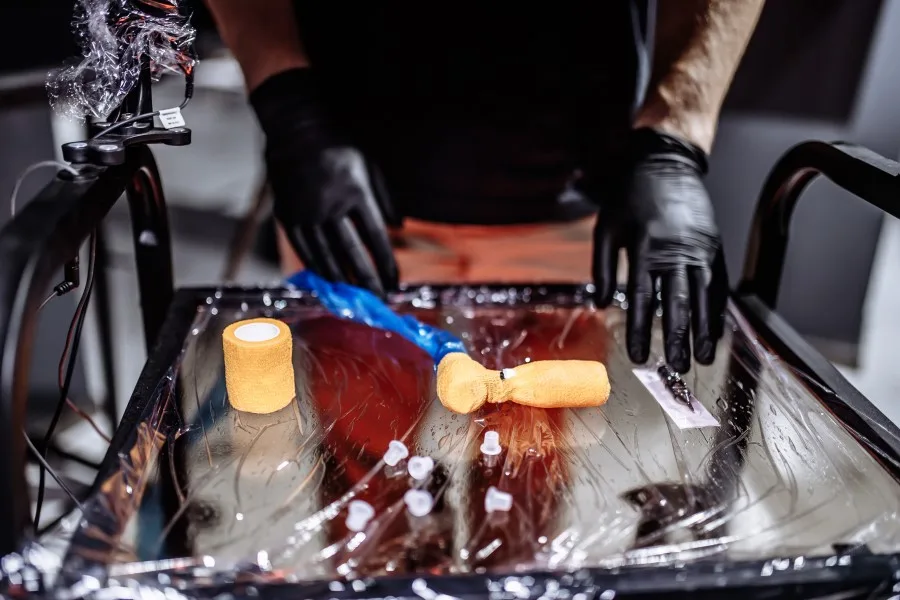
Tattoo ink goes under the skin, and you’ll carry it with you for the rest of your life. To ensure you can trust the safety of your tattoo, the EU is regulating the ingredients in tattoo ink. The green and blue pigments (Green 7 and Blue 15:3) have been banned since the beginning of 2023.
The two pigments Green 7 and Blue 15:3 are particularly important. The REACH Regulation established the first EU-wide rules for tattoo inks at the start of 2022. And since the beginning of 2023, these two pigments have been banned. Why is that? What should you know about your tattoo?

The REACH Regulation and Its Content
The REACH Regulation addresses tattoos and tattoo ink in its annex. The annex took effect in a first phase in January 2022, after which nearly all tattoo inks previously used in Europe were withdrawn from the market. Tattoo studios that use inks that do not comply with REACH face penalties.
The REACH Regulation specifies which ingredients are no longer permitted in tattoo inks, sets the limit values that must be adhered to for the various substances, and defines the mandatory information that must appear on tattoo ink labels. One exception was made: To ensure that inks could still be used at all and to prevent tattoo studios from closing en masse, the pigments Blue 15:3 and Green 7 were granted an extended deadline. Green and blue tattoo inks were thus initially only restricted, but not completely phased out.
It is certainly possible to produce tattoo inks that comply with REACH. However, until now this has been done only to a very limited extent; the inks were inexpensive and widely available. One may debate the merits and drawbacks of the REACH regulation. The fact is that the ingredients in tattoo ink classified as problematic can trigger allergies. Other chemicals that were previously allowed to be used in tattoo ink without regulation can cause genetic mutations and cancer. Since the lymphatic system partially removes and breaks down the tattoo ink, the ink’s ingredients also place a strain on the lymphatic system and the liver. The regulation is therefore not about harassment, but about protecting health and life. Exactly how high the risk associated with the individual ingredients is remains unclear—the relevant committees could only state that they “could not rule out” negative effects and an increased risk of cancer.
Chemicals banned in tattoo ink under REACH have been prohibited in hair dye and other cosmetics since 2009. Extending the ban to tattoo ink is therefore only logical.
Get your tattoo in 3 steps

You’ll receive a personalized tattoo consultation. Contact us via email or Superchat (click the icon in the bottom right corner).

Book your appointment.

In a relaxed atmosphere, we'll make your dream tattoo a reality.

EU-wide problems with paint supplies
Because there were no inks available on the market for a while, tattoo artists were working primarily in black, white, and gray in early 2022. The problem was not only that many inks simply weren’t compliant, but also that manufacturers of REACH-compliant inks couldn’t keep up with the sudden surge in demand. The market was empty until production was adjusted accordingly.
It is entirely possible to produce tattoo inks that comply with REACH. But so far, this has only happened to a very limited extent; the inks were inexpensive and widely available. Understandably, tattoo artists prefer to work with inks they have known for many years and whose performance and handling they have come to appreciate. And it is equally understandable that the inks were purchased as cheaply as possible. These inks have now been legally unavailable for over a year.
It would have been problematic even with black, gray, and white. However, manufacturers were able to produce sufficient quantities of these tattoo inks as early as 2022. With other shades, things didn’t move as quickly, as some required the development of entirely new products. Even the suppliers to the ink manufacturers were facing delivery shortages.
On top of that, there were legal complications, as it was far from clear which documents were required for the legal purchase of tattoo inks. At times, tattoo artists didn’t even know what information to look for or how to identify reputable, legal suppliers. This was because many European manufacturers simply did not carry REACH-compliant inks in their product lines.

About two-thirds of the colors are affected by the ban
In 2022, many appointments were canceled or rescheduled because tattoo artists simply couldn’t get their hands on ink. This will be the case again in 2023. The pigments Green 7 and Blue 15:3 are not only found in green and blue tattoo ink, but also in numerous mixed colors. The range of available products is thus continuing to shrink. Yet, permanently doing without colorful inks is, of course, not an option: Tattoos are art, and art needs color.
By the end of 2022, it was already clear that the pigments Green 7 and Blue 15:3 would no longer be permitted for use as of January 4, 2023. However, not much has happened; despite the experiences of the previous year, manufacturers did not have any alternatives in their product lines. Instead, tattoo studios and tattoo artists were informed that most colors would be missing from the product line starting in 2023.
Inks that were still REACH-compliant in 2022 and contain the pigments Green 7 and Blue 15:3 may no longer be used as of January 4, 2023. This is hitting tattoo artists particularly hard, especially those who stocked up on colorful inks last year. Prices for tattoo inks have risen significantly with the implementation of REACH, yet remaining stock of these inks must still be disposed of.
It is estimated that approximately 66 percent of the tattoo inks used to date contained the pigments Green 7 and Blue 15:3. Since manufacturers were not required to provide detailed information about the ingredients in their inks until January 2022, this figure cannot be narrowed down further. Many manufacturers maintain that there is no viable substitute for these two pigments. Therefore, no new REACH-compliant shades without these two pigments are expected in 2023.

Will tattoos in the future only be done without green and blue ink?
In the future, tattoos will once again be available in green and blue ink. There are already inks available that do not contain these problematic pigments and are fully REACH-compliant. One example is the “Viking” line from the manufacturer Dynamic Inks.
However, some manufacturers have made it clear to tattoo ink suppliers that the range of available shades will be significantly smaller in 2023. This applies to the following manufacturers and product lines:
- Quantum Ink
- World Famous Limitless
- Kuro Sumi Imperial
- Permablend
This list is not exhaustive. In addition to the tattoo colors green and blue, the color ranges listed are currently missing shades of purple, turquoise, brown, and gray.
If you were planning to get a tattoo featuring plants or a marine theme in 2023, this will naturally be a big blow. If you don’t want to give up on your desired design, you’d be better off waiting another year or two until the full color palette is available again.
Or maybe you’d like to talk to your tattoo artist about it. Artists are creative—they always find a solution. And you might even like the alternative design they suggest for your desired motif, without the problematic colors, even better. We hope so!