
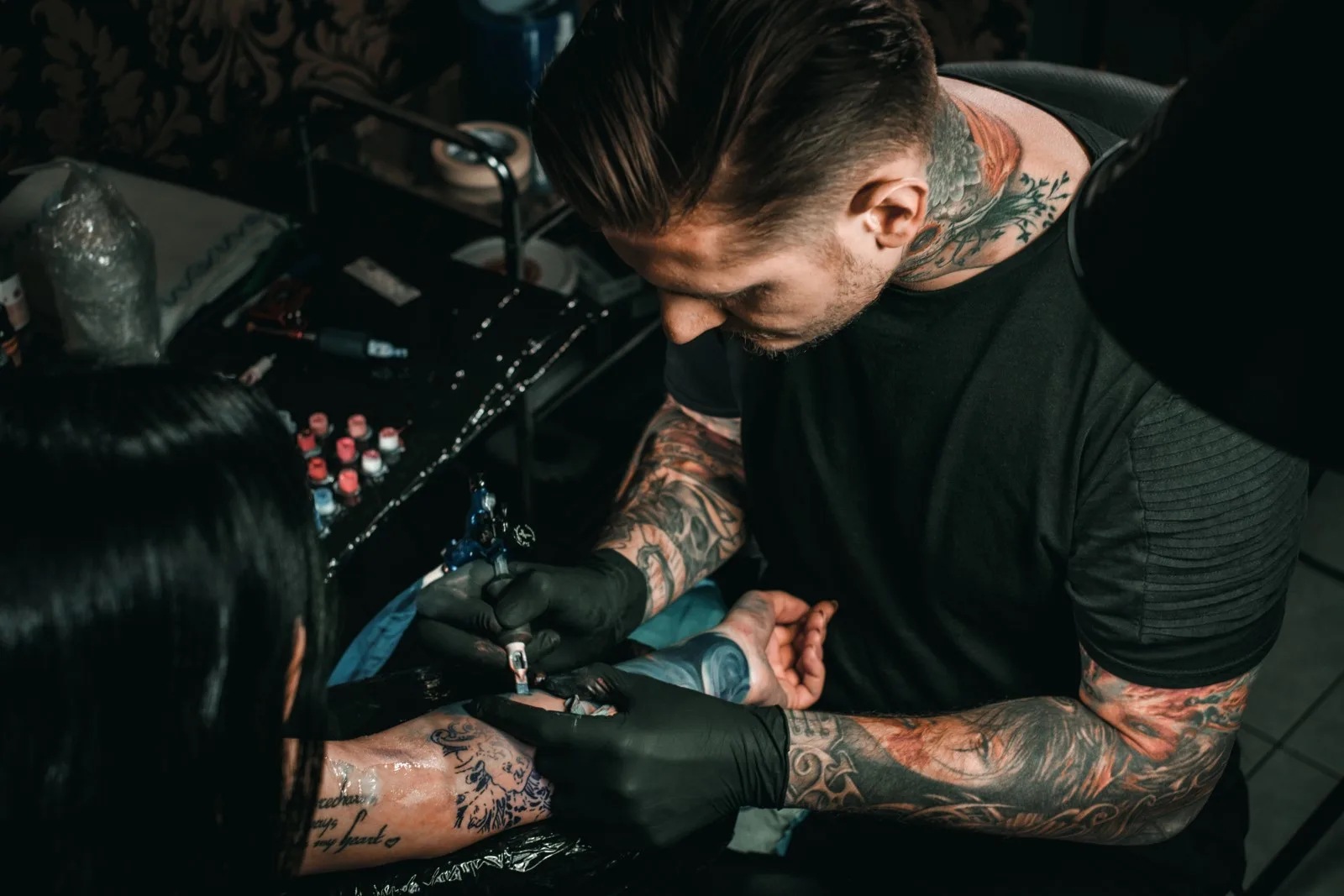
A tattoo for life? That’s not always the case. What you got tattooed in your youth may no longer appeal to you by the time you’re 30, 40, or 50. Don’t worry: you can hide your “youthful indiscretions” with a cover-up tattoo.
A tattoo is a lifelong commitment. But do you always know what you want? People change, and that’s completely normal. You’re constantly evolving, and at some point, old tattoos may no longer suit you—which is totally natural. There are two ways to get rid of a tattoo: you can have it removed with a laser, or you can opt for a cover-up tattoo.
The right option for you depends not only on your personal preferences, but also on the type and size of your old tattoo and the area of the body where it is located. In many cases, by the way, it comes down to a combination of approaches: first, laser treatment is performed, then a cover-up tattoo is created. This is because, contrary to the grandiose promises made by many doctors, laser removal cannot be used to remove all ink residues.
Table of Contents
- Laser removal: How does it work?
- It's not entirely safe, so please be careful!
- Cover-up tattoos to transform old tattoos into new ones
- Cover-up tattoos don't always work!
- The details – how artists work
- Different techniques for covering
- These styles are perfect for cover-ups
- Even a cover-up tattoo needs to be taken care of

Laser removal: How does it work?
If, after giving it a lot of thought, you’re still convinced that your old tattoo really needs to go, then laser removal is probably the right choice. However, it can be painful and often takes longer than getting the tattoo in the first place. Nevertheless, laser treatments are considered safe compared to older methods that used acid, files, and/or liquid nitrogen.
The laser emits intense, short flashes of light at a specific wavelength onto the tattoo from a very short distance. The flashes of light are barely visible, but penetrate up to 4 millimeters deep into the skin. They shatter the color pigments into tiny fragments, which the body breaks down via the lymphatic system. Most of these particles are excreted by the kidneys and intestines, while some pigments and fragments will likely remain in the body.
Needless to say, this isn’t done in a single session, but over several. The number of sessions you’ll need depends on the size of the tattoo, as well as its age and design. Some laser treatments can take years. The situation is different if the laser treatment is “only” intended to prepare a tattoo for a cover-up, which can usually be completed in just a few sessions.
Your tattoo in 3 steps

During your first consultation, you will receive personalized information about your tattoo. Contact us via email or SuperChat (icon in the bottom right corner).

Make an appointment.

Your dream tattoo will be created in a relaxed atmosphere.

It's not entirely safe, so please be careful!
Many companies offer laser tattoo removal. However, only doctors are legally permitted to perform these procedures. They do not have to work in a doctor’s office, but can be employed by a tattoo studio and offer other cosmetic treatments as dermatologists.
Make sure that the doctor treating you has the appropriate training in laser treatment, since lasers are dangerous. High-quality medical laser systems are safe provided they are operated correctly. If they are not operated correctly or if other laser systems are used, the treatment is not safe, as it can cause burns, inflammation, and pigmentation disorders, often resulting in scars. Under a law enacted in January 2021, laser removal must only be performed by doctors with the appropriate training.

Cover-up tattoos to transform old tattoos into new ones
A cover-up tattoo is always a good option if you like tattoos in general but just can’t decide on a single design. There are two options: the first involves choosing a pure cover-up tattoo, in which case an old tattoo is incorporated into a new design as is. This means it no longer stands out, but becomes part of a new design.
The second option involves partially removing or fading an old tattoo using laser treatment. What remains of it can then be incorporated into the new tattoo, or the new tattoo can cover the remnants of the old one.
Cover-up tattoos require a great deal of experience and artistic skill. Therefore, you should definitely look for an artist who has experience with cover-up tattoos. Only then can you be sure that the result will be convincing.

Cover-up tattoos don't always work!
A cover-up tattoo isn’t like a sticker that you simply place over an old tattoo to make it disappear. Old tattoos don’t disappear at all, but hopefully blend seamlessly into the new tattoo. Therefore, the design of the cover-up tattoo must not only suit you and your current life situation, but also be suitable for making the old tattoo fade into the background. “Putting something around it” is not enough. A cover-up tattoo is not a frame, but makes an old tattoo visually disappear.
This is no easy task. Take your time when looking for a tattoo artist. Cover-up tattoos are the ultimate challenge in tattoo art. Take a close look at the portfolios of the artists you’re considering. Make sure there’s great chemistry between you and your artist. Extensive discussions and recommendations that you should consider carefully—and then set aside—are an essential part of finding the right artist. Seek advice and ask questions.
Not surprisingly, all this takes time, patience, and money, but it’s worth it, since it avoids the risk of having to get a cover-up tattoo in a few years’ time.
The details – how artists work
As mentioned above, when creating a cover-up tattoo, the artist incorporates the old design into the new one. As a result, the new tattoo is significantly larger than the old one. The colors and shapes must match, although the style of the cover-up tattoo is often the same or very similar to your old one. A classic black skull (realism) can, for example, be incorporated into an Asian-style tattoo. However, this might be difficult with other designs.
The process can be described as follows: the artist creates a design to be placed over and around the old tattoo like a blanket, so that the old tattoo becomes part of this “blanket,” which, naturally, will be larger than the original tattoo. The new design is created in such a way that the focus is on an area that was previously untattooed—thus drawing the eye away from the old tattoo.
The colors of the new tattoo must be chosen so that the old one blends in. The pigments of the old and new tattoos will mix, which is why a cover-up tattoo always requires several layers of color. Some pigments can only be covered with black ink, whereas others offer more options. However, the cover-up tattoo will always be darker than the old one. This is why very dark tattoos are lightened using laser treatment before the cover-up tattoo is applied.
Different techniques for covering
There are many different ways to create a cover-up tattoo:
1. By touching up existing designs: if your tattoo has lost only a little color and definition, you can simply touch it up. Then it will look brand new again.
2. By covering up existing tattoos: small, light-colored tattoos are suitable for this technique. The old design is covered up with a new tattoo. Naturally, the new tattoo is larger and darker than the old one.
3. By incorporating old tattoos into a new design: if you don’t want to or can’t completely cover up your old tattoo, you can also have it incorporated into a new design. Sometimes this works wonderfully well stylistically (e.g., when the small, single rose on the forearm blends into a new carpet of flowers), but it can also result in a complete stylistic break, which is known as a “blast-over.”
These styles are perfect for cover-ups
Not every tattoo can be covered up. A few requirements must be met for the new tattoo to look really good. Important factors include size, color, the depth of the old tattoo, and your preferences for the new one. These requirements determine whether your tattoo is suitable for a cover-up:
- The tattoo is fairly small; there is plenty of open skin around it, so it's an easy area to tattoo.
- Your tattoo is monochrome or features just a few colors and is quite bright.
- Your tattoo has already faded a bit and looks a little faded.
- Your tattoo consists of simple letters, numbers, or lettering that your artist transforms into a colorful design.
- Curved lines and shadows can be easily incorporated into a new motif (the rose mentioned earlier is one such motif) or can be concealed in the dark shadows of a new motif.
Intricate styles such as dotwork can be better concealed with a cover-up tattoo, but you cannot make a large tattoo disappear using dotwork. The style of the new design will always be traditional, neo-traditional, or tribal; biomechanical designs are also suitable.
Even a cover-up tattoo needs to be taken care of
Just like your first tattoo, your cover-up tattoo also needs proper care. After all, the design should retain its vibrant color for a long time, and its lines should remain clear and sharp. Make sure your cover-up tattoo heals properly!
In addition, you can also use a tattoo to conceal unsightly scars caused by accidents or burns. However, the scar must be completely healed before this can be done. Be sure to find a tattoo artist who has experience with the different skin structures of scar tissue and knows how to work with it. Since scar tissue heals differently, a cover-up tattoo will likely require several sessions and take months to heal.