Today, most tattoos are a personal choice—custom-made and therefore one-of-a-kind. And that’s a good thing; after all, your tattoo is a visible part of your life story right there on your skin.
Nevertheless, there are a few motifs that are frequently used, albeit in unique interpretations. The symbolism of these motifs is clear. We’ll introduce these motifs and explain their meanings. Maybe you’ll find some inspiration here?

The Lion
A wild mane, defined muscles, and a direct gaze: The lion is the king of the animals, and you can tell that right away. He symbolizes strength and courage. If you have a lion as a tattoo design, people will associate these qualities with you as well. But the lion conveys even more, depending on the culture it comes from (and which is defined by the tattoo style):
- Strength and Power
- Glory, Honor, and Victory
- Grace
- Justice
- Wisdom and intelligence
- Family and Loyalty
So, no matter how wild your tattoo design may look, it’s actually just a pretty tame little kitten.
Get your tattoo in 3 steps

You’ll receive a personalized tattoo consultation. Contact us via email or Superchat (click the icon in the bottom right corner).

Book your appointment.

In a relaxed atmosphere, we'll make your dream tattoo a reality.

The Mandala
Children enjoy coloring mandalas, and so do some adults. These point-symmetrical designs radiate calm and harmony, which is why coloring mandalas is considered a source of relaxation and harmony.
The word “mandala” comes from Sanskrit, the language of ancient India. The term describes a sacred circle around which everything revolves—a kind of focal point. In Hinduism and Buddhism, mandalas are used as aids to meditation. Their symmetrical arrangement is said to create the calm necessary for meditation.
Not all mandalas are round; there are also triangular, square, and polygonal versions. Numbers and incorporated motifs are what give these tattoo designs their meaning:
- The circle represents the entire universe or the soul.
- The triangle combines positive and negative elements.
- The square represents the four cardinal directions, but it can also symbolize strength.
- The number 1 represents the one God (in monotheism) or the human being as an individual.
- The number 5 represents love and inner balance.
- The number 8 symbolizes harmony and balance.
- The eye symbolizes the Buddhist Eye of God, or alternatively, the inner self.
- In Hinduism, the wheel symbolizes the cyclical nature of the world, destiny, but also motivation and vigor.
- The flower expresses grace.

The Anchor
Anchor tattoo designs actually have their roots in seafaring; the anchor was the identifying symbol of sailors who crossed the Atlantic. Today, the anchor symbolizes hope, faith, and home. It provides strength and support. In addition, the anchor can offer the stability one seeks in difficult times, but it can also represent the person from whom one hopes to receive that stability.
If you carry a longing for the sea and for adventure within you, the anchor is your symbol too. However, it always symbolizes the hope of finding a safe harbor or returning to one.

The Compass
In this age of navigation apps on smartphones, you probably don’t need a compass anymore, but compasses are still popular as tattoo designs. This motif also has its roots in seafaring. For sailors, a compass tattoo was a kind of talisman. The compass was meant to protect them in treacherous waters and rough seas, showing them the way home. Even today, the compass remains a symbol that suggests protection, safety, guidance, and direction.
Of course, the compass can also represent a love of the sea and symbolize home. But many people also associate the compass with good luck. While a compass, as a navigational tool, always points north (with the exception, of course, of Jack Sparrow’s compass), the compass on your skin points to what matters most to you. That could be the north. But it could also be another tattoo design—your heart, your head, or whatever. Even the most popular tattoo designs are still individual designs, and it’s you who gives them meaning through your personal arrangement and orientation.

The Rose
The rose is one of the most popular tattoo designs worldwide. Roses are timeless; they always look elegant yet playful. These designs have long symbolized femininity; sailors used to get rose tattoos to remember their wives, girlfriends, or mothers who were far away. In this way, they always had their loved ones with them—at least symbolically.
Today, the rose has many meanings, depending on its color:
- White roses symbolize innocence, purity, and fidelity.
- Black roses symbolize survival in difficult times and represent courage and rebellion.
- Yellow: Friendship, happiness, warmth, optimism.
- Red: Love, passion, sensuality.
- Orange: Hope, optimism, respect, gratitude.
- Pink: beauty, elegance, youth.
- Blue: The unattainable, dreams, fascination, little secrets.
In addition to the color, the specific design of the rose is crucial. Roses with thorns symbolize painful times, while a wilted rose represents more than just the transience of life as a tattoo motif. When depicted with leaves, however, the rose symbolizes new life and happiness, as well as protection for loved ones.
The Skull
The skull is a true classic; for centuries, it has served as a symbol of mortality and death in art. And that is precisely the meaning the skull holds as a tattoo design. If you’ve had to say goodbye to a loved one or have fought your own battle for survival, the skull is the design for you.
But the skull can also symbolize any positive change in your life. It represents the past—the things that no longer play a role in your life, the things you have overcome. In that sense, the skull is always a good-luck charm that gives you strength.
In some social groups, however, a skull tattoo is also seen as a symbol of a wild and perhaps dangerous lifestyle.

The Viking
Viking tattoos are actually seafarer tattoos, because those childless men from the North were exactly that. But of course, the tattoo scene doesn’t just recognize the Vikings themselves as tattoo motifs—it embraces their entire culture. We now know that the Northmen themselves were also tattooed. The best-known and most popular tattoo motifs from this cultural tradition are:
- The Tree of Yggdrasil: The World Tree connects the nine existing worlds. It speaks of faith and the interconnectedness of the worlds.
- Troll Cross: The Norse actually feared crosses. The troll cross is a twisted piece of metal that was believed to offer protection against evil and black magic.
- Valkyries: These warrior women decided in battle who would survive and who would die. As a tattoo motif, they symbolize power and control.
- Thor: The god of thunder with the hammer is the protector of humanity. As tattoo designs, both Thor and his hammer symbolize a protector.
- Aegishjalmur: The Helm of Awe is an eight-armed figure said to represent a trident. The tattoo symbolizes protection and strength.
- Odin: The god represents healing, death, and knowledge. He is often symbolized by three interlocking drinking horns.
- Vegvísir: This is the Vikings' compass. It symbolizes direction.
Floral motifs
Flowers are a gift from nature, and we all love to give them as gifts. Originally, these beautiful blooms symbolized youth and beauty. Today, flowers used as tattoo designs represent a connection to nature, playfulness, and creativity. Currently, it’s trendy to assign a flower to each month of birth. Caution: There are different systems, and the flowers have different additional meanings depending on the system!
- January: Carnation (love, friendship)
- February: Violets (mindfulness, loyalty, modesty)
- March: Daffodil (new beginnings, courage, courtesy)
- April: Daisies (happiness, simplicity)
- May: Lily of the valley (chaste love, humility)
- June: Rose
- July: Larkspur (enthusiasm, openness, lightheartedness)
- August: Gladiolus (honesty, strong character)
- September: Aster (wisdom, courage)
- October: Marigold (Sympathy, Compassion)
- November: Chrysanthemum (optimism, loyalty, happiness)
- December: Poinsettia (joy of celebration, success)
The Heart
Hearts, of course, always represent love and affection. But what about a broken heart? It symbolizes sadness, pain, and loss. A winged heart, on the other hand, represents freedom and independence, while the Celtic heart (tribal-style heart) symbolizes unity and strength. A bleeding heart signifies loneliness and hurt, while a burning heart signifies passion.
When the burning heart is combined with an anchor and a cross, you’ll be wearing the triad of faith, love, and hope under your skin. This design is also known as the “sailor’s grave” and is a true classic.
A heart with a lock symbolizes a bond between lovers, with the partner usually carrying a key. Couples often get half of the heart tattooed on each of their bodies, in which case they are likely in a long-distance relationship. A heart with a dagger symbolizes conflict, but also courage and bravery. An anatomical heart, on the other hand, represents endurance and strength.
The Dragon
As a mythical creature, the dragon appears in both Norse and Asian mythology. In the West, dragons are often seen as evil, while in Asia they are regarded as saviors and essential to the natural balance. As a tattoo motif, however, the dragon transcends its traditional image, having taken on many additional meanings over the centuries:
- An individual's struggle with oneself
- Lucky charm
- Guardians of treasures and/or secrets
- Jealousy
- Revenge
- Power
- Strength
- Protection
- Family
- long life
The last three meanings are inspired by Japanese dragons, which, incidentally, are water creatures and are considered the counterparts to the tiger (fire and desert) in mythology.
The Grand Piano
Wings are associated with angels and birds, but they often appear on their own as a tattoo design. A tattoo like this can symbolize a wide variety of things:
- Loss (often following the death of a loved one)
- Freedom and Independence
- superiority
- Strength
- Courage
- Peace
- Divine (belonging to Christian culture)
If a symbol is incorporated between two wings, the meaning of the tattoo arises from the interplay of the motifs.
The semicolon
A punctuation mark as a tattoo design—surely that’s just something for linguists, right? No, not at all! The semicolon symbolizes the self-determined course of life and gives people in extreme situations hope like no other symbol. And yet it’s so small and unobtrusive that it can be worn on almost any part of the body.
The Triangle
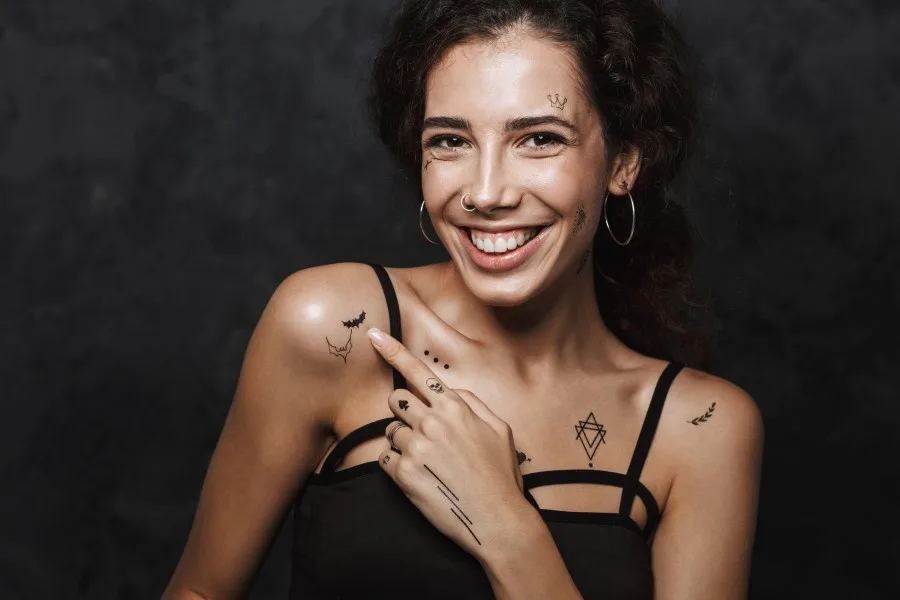
Triangles are the most popular tattoo designs today. The triangle represents the elements; when pointed downward, it symbolizes fire and energy. When pointed upward, it symbolizes air and time. For Harry Potter fans, the triangle has a meaning that you’d better discover for yourself in the books.
As a Christian motif, the triangle symbolizes the Trinity. Beyond that, the triangle can also represent the past, present, and future. The triad of mind, body, and soul is also represented by a triangle.