
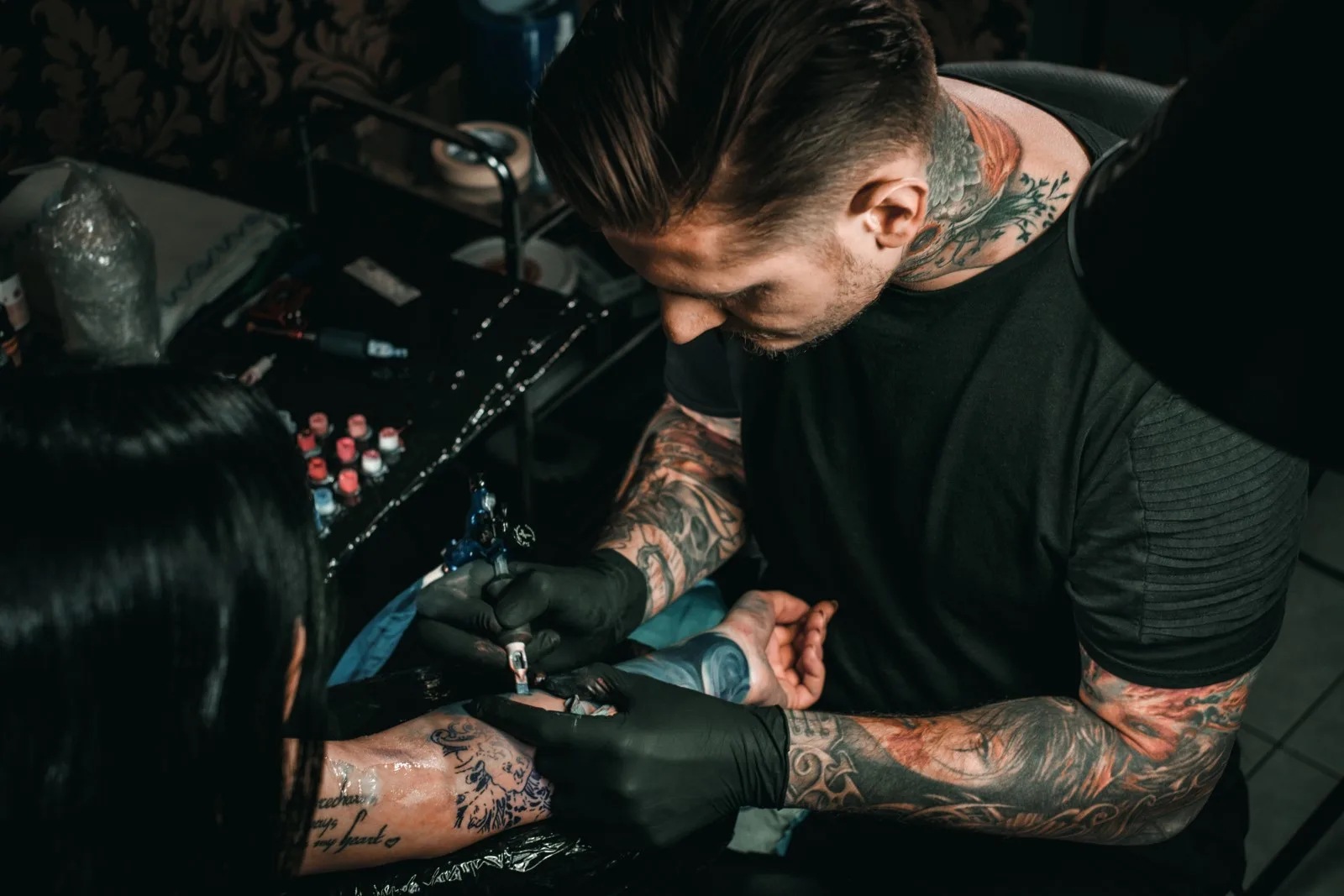
A tattoo for life? That’s not always the case. You might not like the tattoo you got in your youth once you’re in your 30s, 40s, or 50s. Don’t worry: you can cover up those “youthful indiscretions” with a cover-up.
A tattoo is a decision for life. But do you always know what you want? People change, and that’s perfectly normal. You grow and evolve, and at some point, the tattoo might no longer suit you. That’s perfectly natural. There are two ways to part with the tattoo: you can have it removed with a laser, or you can opt for a cover-up.
Which option is right for you depends not only on your personal preferences, but also on the type and size of the tattoo, as well as the location on your body. In many cases, by the way, it comes down to a combination of approaches: first, the tattoo is removed with a laser, and then a cover-up tattoo is applied. This is because, contrary to the bold promises made by many doctors, not all traces of ink can be removed with a laser.
Table of Contents

Lasers: How do they work?
If, even after giving it a lot of thought, you’re still convinced that your old tattoo really needs to go, then laser removal is probably the right choice. However, laser removal can be painful and often takes longer than getting the tattoo in the first place. Nevertheless, laser treatments are considered safe compared to the methods commonly used in the past, such as acid, files, and/or liquid nitrogen.
The laser fires intense, short flashes of light at a specific wavelength onto the tattoo from a very short distance. The flashes of light are barely visible, but penetrate up to 4 millimeters deep into the skin. They break down the tattoo’s color pigments into tiny fragments, which the body eliminates via the lymphatic system. You excrete these particles through your kidneys and intestines, at least for the most part. Some of the pigments and fragments likely remain in the body.
Of course, this isn’t done in a single session, but over several appointments. The number of sessions required depends on the size of the tattoo, the age of the ink, and the design. Some laser treatments can take years. The situation is different if the laser treatment is “only” intended to prepare the tattoo for a cover-up. That can usually be accomplished in just a few sessions.
Get your tattoo in 3 steps

You’ll receive a personalized tattoo consultation. Contact us via email or Superchat (click the icon in the bottom right corner).

Book your appointment.

In a relaxed atmosphere, we'll make your dream tattoo a reality.

This isn't entirely without risk, so please take note!
Many companies offer laser tattoo removal. However, by law, only doctors are permitted to perform this procedure. They do not have to work in a medical practice; instead, they can be employed at a tattoo studio, and as dermatologists, they can also offer other cosmetic treatments.
Please make absolutely sure that the treating physician has the appropriate training for laser treatment! Lasers are dangerous. High-quality medical laser systems are safe when operated correctly. If operated improperly or with other types of laser systems, the treatment is not safe and can cause burns, inflammation, and pigmentation disorders, often resulting in scarring. Since January 2021, it has been a legal requirement that laser removal procedures may only be performed by doctors with the appropriate training.

Cover-up Tattoo: Turning Old into New
A cover-up is always a good option if you generally like tattoos but just can’t stand that particular design anymore. There are two possibilities: Either you opt for a pure cover-up, in which case the old tattoo is incorporated into the new design exactly as it is. This way, it’s no longer noticeable but becomes part of the new design.
The second option is to partially remove the old tattoo or fade it using laser treatment. Whatever remains can then be incorporated into the new tattoo. Alternatively, the new tattoo can cover up the remnants of the old one.
Cover-up tattoos require a lot of experience and artistic skill. So you should definitely look for an artist who has experience with cover-ups. That’s the only way you can be sure you’ll be happy with the result.

Cover-ups don't always work!
A cover-up isn’t like a sticker that you simply place over your old tattoo to make it disappear. The old tattoo doesn’t disappear at all; instead, it (hopefully) blends seamlessly into the new tattoo. So the design of the cover-up must not only suit you and your current life situation, but also be able to make the old tattoo fade into the background. It’s not enough to just “tattoo around it.” A cover-up isn’t a frame; it actually makes the old tattoo visually disappear.
This is no easy task. Take your time when looking for a tattoo artist. Cover-ups are the pinnacle of tattoo art. Take a close look at the portfolios of the artists you’re considering. Make sure there’s “good chemistry” between you and your artist. Extensive discussions and recommendations that are carefully considered and then ultimately rejected are an essential part of finding the right artist. Seek advice and ask questions.
Of course, all of this takes time, patience, and money. But it should be worth it to you. After all, you don’t want to risk having to fix the cover-up in a few years.
The Details: How the Artists Work
We’ve already mentioned this: With a cover-up tattoo, the artist incorporates the old design into the new one. This means the new tattoo is significantly larger than the old one. Colors and shapes need to match, and the style of the cover-up is often the same or very similar to your old tattoo. A classic black skull (realism) can be integrated into an Asian-style tattoo to some extent. But with other designs, this becomes difficult.
Structurally, it works something like this: The artist creates a design that wraps around the old tattoo like a blanket. The old tattoo thus becomes part of this “blanket,” which, logically, must be larger than the original tattoo. The new design is created in such a way that the focus is on an area that hasn’t been tattooed before—thus drawing the eye away from the old tattoo.
The colors of the new tattoo must be chosen so that the old one blends in. The pigments from the old and new tattoos will mix, which is why a cover-up always requires multiple layers of ink. Some pigments can only be covered with black, while others offer more options. In any case, the cover-up will end up darker than the old tattoo. Very dark tattoos are therefore bleached with laser treatment before the cover-up is applied.
Various techniques for covering
There are actually quite a few different ways to create a cover-up:
1. Touching up existing designs: If your tattoo has simply lost some color and definition, it can easily be touched up. The tattoo is retouched through a process known as a touch-up, and it will look as good as new afterward.
2. Covering up the original: Small, light-colored tattoos are ideal for this type of cover-up. In this process, the old design is covered with a new tattoo. Naturally, the new tattoo will be larger and darker than the old one.
3. Incorporating old tattoos into a new design: If you don’t want to or can’t completely cover up your old tattoo, you can also have it incorporated into a new design. This can sometimes work wonderfully from a stylistic perspective (such as when a small, solitary rose on the forearm blends into a new floral pattern), but it can also result in a complete stylistic mismatch. This is referred to as a “blast-over.”
These styles are suitable for cover-ups
Not every tattoo can be easily covered up with a cover-up. A few conditions must be met for the new tattoo to look really good. Important factors include the size, color, and depth of the old tattoo, as well as your preferences for the new tattoo. These conditions make your tattoo a good candidate for a cover-up:
- The tattoo is fairly small, with plenty of open skin around it in an area that’s easy to tattoo.
- Your tattoo is monochromatic or uses only a few colors and is fairly light in tone.
- The tattoo has faded a bit and looks a little "faded."
- Your tattoo consists of simple letters, numbers, or lettering that your artist transforms into a colorful design.
- Curved lines and shadows can be easily incorporated into a new motif (the rose mentioned earlier is one such motif) or concealed within the dark shadows of a new motif.
Delicate styles, such as dotwork, are easier to cover up with a cover-up tattoo, but you can’t hide a large tattoo under dotwork. The new design will always consist of traditional, neo-traditional, or tribal styles; biomechanics are also suitable for this purpose.
Even a cover-up needs to be maintained
Just like your first tattoo, your cover-up needs proper care. After all, you want the design to retain its vibrant colors for a long time, and the outlines to remain clear and sharp. Make sure the cover-up heals properly!
By the way, you can also use a tattoo to cover up unsightly scars from accidents or burns. However, the scar must be fully healed first. Make sure you find a tattoo artist who has experience working with the different skin texture of scar tissue and knows how to handle it. Scar tissue heals differently, so the cover-up will likely require several sessions and take months to heal.